
South Africa Needs Growth, Inclusion, and Competitiveness, Not Failed Policies Repackaged
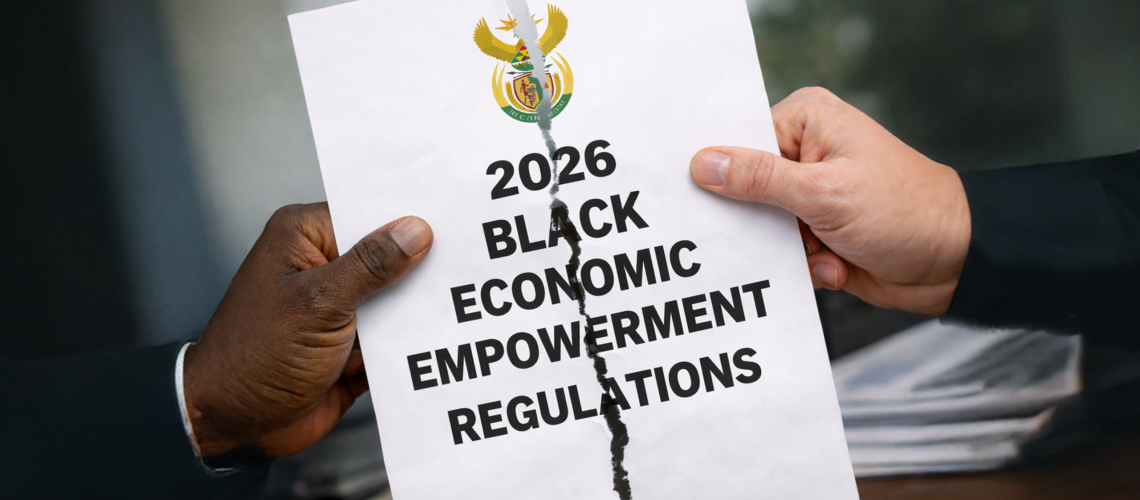
Free SA has launched a national campaign opposing the proposed 2026 amendments to the Broad-Based Black Economic Empowerment (B-BBEE) Codes, warning that the draft regulations will deepen economic stagnation, deter investment, and further entrench race-based economic engineering at the expense of growth and job creation.
The organisation argues that after more than two decades of implementation, the BEE framework has failed to deliver meaningful, broad-based upliftment. Instead, it has created a compliance-heavy system that benefits a politically connected elite while discouraging entrepreneurship and constraining small and medium enterprises.
The campaign, titled “Stop the 2026 BEE Regulations”, calls for the complete withdrawal of the draft Codes and a decisive shift towards policies that prioritise economic growth, equal opportunity, skills development, and open markets over coercive redistribution.
At the heart of Free SA’s objection is the principle underpinning BEE itself, that economic outcomes should be engineered through racial classification and state-managed compliance targets.
“South Africa does not need more social engineering. It needs growth,” said Gideon Joubert, spokesperson for Free SA. “True empowerment comes from expanding opportunity, not from forcing businesses into ever more complex scorecards and quasi-tax mechanisms.”
Free SA maintains that BEE has not achieved mass economic inclusion, but rather concentrated benefits among a small group of politically connected individuals, while the broader population remains locked out of meaningful economic participation.
The draft 2026 Codes significantly expand scorecard weightings and introduce new mandatory sub-minimum requirements, further increasing compliance costs.
Free SA warns that these measures will disproportionately harm small businesses, startups, and entrepreneurs who lack the resources to navigate complex regulatory frameworks. Instead of encouraging enterprise and innovation, the proposed regulations risk stifling both.
“South Africa’s unemployment crisis cannot be solved through compliance paperwork,” Joubert added. “It will be solved by making it easier, not harder, to start, grow, and sustain a business.”
One of the most concerning elements of the draft regulations is the introduction of a Transformation Fund under Enterprise and Supplier Development provisions.
Free SA argues that this fund effectively operates as a compulsory quasi-tax on businesses, diverting capital away from productive investment and into a state-linked structure. Such measures, the organisation contends, undermine investor confidence and weaken property rights.
“Forcing businesses to contribute to a centralised fund under the guise of transformation will only drive capital away at a time when South Africa desperately needs investment,” said Joubert. “You cannot tax your way to growth.”
Free SA is advocating for a fundamental shift in economic policy, including:
- The immediate withdrawal of the 2026 Draft BEE Codes
- A clear move away from race-based economic engineering
- Policies focused on growth, job creation, skills development, and entrepreneurship
- Voluntary, incentive-based empowerment rather than coercive compliance
- Deregulation and meaningful support for SMEs
The organisation has also urged South Africans to submit formal objections to the draft regulations before the public comment deadline of 31 March 2026. You can submit your comments here.
Free SA is calling on citizens, entrepreneurs, and business owners to participate in the public comment process and demand a modern, inclusive, and growth-oriented alternative to the current BEE framework.
“South Africa does not need more regulation,” concluded Joubert. “It needs more opportunity. If we are serious about inclusion, we must build an economy where merit, innovation, and enterprise, not political engineering, determine success.”